
Scope 3 emissions are the indirect greenhouse gas emissions that occur throughout a company’s value chain, both upstream and downstream from its direct operations. Unlike Scope 1 emissions (direct emissions from owned sources) and Scope 2 emissions (indirect emissions from purchased energy), Scope 3 captures everything from the extraction of raw materials your suppliers use to the end-of-life disposal of products your customers buy. For most organizations, these value chain emissions represent 70 to 90 percent of their total carbon footprint.
Understanding Scope 3 matters because you can’t manage what you don’t measure. As corporate climate commitments intensify and regulatory frameworks tighten in 2026, organizations face growing pressure from investors, customers, and regulators to account for their full environmental impact. The Securities and Exchange Commission’s climate disclosure rules, the EU’s Corporate Sustainability Reporting Directive, and emerging supply chain transparency laws all demand comprehensive Scope 3 accounting.
The challenge is real. Scope 3 emissions span 15 distinct categories defined by the Greenhouse Gas Protocol, from purchased goods and services to employee commuting, business travel, and the use of sold products. Each category requires different data collection methods, calculation approaches, and reduction strategies. A hospital system’s Scope 3 footprint looks vastly different from a university’s or a manufacturing facility’s.
This article breaks down what Scope 3 emissions actually include, how the measurement framework operates, and practical strategies to integrate Scope 3 management into your broader energy sustainability program. You’ll learn which categories matter most for your sector and how leading organizations turn Scope 3 accounting from a compliance burden into a competitive advantage.
What Scope 3 Emissions Mean for Your Organization

Scope 3 emissions are the indirect greenhouse gas emissions that occur across your entire value chain, both upstream and downstream from your operations. They include everything from the products and services you purchase to the emissions created when customers use what you produce or provide. Unlike Scope 1 emissions (direct emissions you control) and Scope 2 emissions (emissions from your purchased electricity and heat), Scope 3 encompasses all the other indirect emissions tied to your organization’s activities.
For most organizations, Scope 3 represents the largest portion of their carbon footprint, often 70% to 90% of total emissions. A university might directly control emissions from campus boilers and vehicles (Scope 1) and from purchased electricity (Scope 2), but the majority of its carbon impact comes from faculty air travel, student commuting, purchased goods, food services, and construction projects. A hospital’s Scope 3 footprint typically includes medical supplies, pharmaceutical products, patient and visitor travel, and waste disposal.
- Scope 1 Emissions
- Direct emissions from sources your organization owns or controls, such as on-site boilers, fleet vehicles, or refrigerant leaks. A university’s natural gas heating system or a government agency’s patrol vehicles generate Scope 1 emissions.
- Scope 2 Emissions
- Indirect emissions from purchased electricity, steam, heating, or cooling consumed by your facilities. When a hospital buys electricity from the grid to power its operations, those are Scope 2 emissions.
- Scope 3 Emissions
- All other indirect emissions in your value chain, including purchased goods and services, business travel, employee commuting, waste, and downstream activities. A business’s supplier manufacturing processes, employee commutes, and product shipping all generate Scope 3 emissions.
The distinction matters because each scope requires different management strategies. You have direct control over Scope 1 sources and can make purchasing decisions that influence Scope 2. Scope 3, however, requires collaboration with suppliers, contractors, employees, and sometimes customers to achieve meaningful reductions. A procurement officer making vendor selections, for instance, directly influences upstream Scope 3 emissions even though those emissions don’t occur on your property or show up on your utility bills.
Understanding this structure helps you identify where your organization’s true carbon impact lies and where reduction efforts will deliver the greatest results.
How Scope 3 Emissions Work in Practice

Scope 3 emissions occur whenever your organization’s activities trigger carbon releases through someone else’s operations, a supplier manufacturing your products, an employee driving to work, a customer using what you sold them, or a logistics company transporting your goods. Unlike Scope 1 emissions from facilities you own or Scope 2 from the electricity you purchase directly, Scope 3 encompasses the entire web of indirect activities your business depends on but doesn’t directly control.
This lack of direct control creates the central challenge. A hospital can install meters on its boilers and track Scope 1 emissions with precision. It can review utility bills to calculate Scope 2. But measuring the carbon footprint of thousands of medical supplies from dozens of manufacturers, waste hauled to distant facilities, or staff commutes from scattered neighborhoods requires collecting data from external parties who may not track emissions at all.
The responsibility chain gets complicated because Scope 3 emissions are someone else’s Scope 1 or 2. When your supplier runs their factory to make your order, those emissions appear in their Scope 1 but your Scope 3. This shared responsibility means neither party can solve the problem alone. You need suppliers willing to measure, report, and reduce their footprint. They need customers who value lower-carbon options and will support the investment required.
The mechanics of reduction work differently too. Cutting Scope 1 emissions might mean upgrading your equipment. Reducing Scope 3 means changing procurement specifications, shifting to local suppliers, redesigning products for lower lifecycle emissions, or negotiating with logistics partners for cleaner transportation. Each decision requires cross-functional coordination between procurement, operations, and sustainability teams.
Data collection typically starts with estimates based on spending categories and industry averages, then progresses toward supplier-specific data as relationships mature. A university tracking business travel might begin with expense reports and standard emissions factors per mile flown, then work with preferred airlines to access more precise fuel consumption data. The goal is continuous improvement in both accuracy and impact, not perfection from day one.
The 15 Categories of Scope 3 Emissions
The Greenhouse Gas Protocol organizes Scope 3 emissions into 15 distinct categories, split between upstream activities (occurring before your operations) and downstream activities (happening after your products or services leave your control). Understanding these categories helps you identify where your organization’s emissions actually occur and prioritize reduction efforts.
Upstream Categories (1-8)
Category 1, Purchased Goods and Services, covers emissions from everything you buy, office supplies, IT equipment, food service items, medical supplies, or maintenance materials. For most organizations, this represents the largest single category. A hospital purchasing surgical instruments, a university buying lab equipment, or a government agency procuring office furniture all generate Category 1 emissions.
Categories 2 and 3 address Capital Goods and Fuel-and-Energy-Related Activities. Capital goods include buildings, vehicles, and major equipment, the construction emissions from a new campus building or hospital wing. Category 3 captures transmission losses and upstream emissions from your purchased electricity and fuels.
Category 4, Upstream Transportation and Distribution, tracks emissions from shipping purchased products to your facilities. Category 5, Waste Generated in Operations, includes the treatment and disposal of your solid waste, wastewater, and recycling.
Category 6, Business Travel, matters significantly for professional services organizations, universities with extensive research programs, and agencies with field operations. Flights to conferences, rental cars, and hotel stays all fall here. Category 7, Employee Commuting, captures how your staff gets to work daily. Category 8, Upstream Leased Assets, applies only if you operate in facilities someone else owns and controls.
Downstream Categories (9-15)
Category 9, Downstream Transportation and Distribution, covers shipping products to customers, less relevant for service organizations but critical for manufacturers. Categories 10 and 11 address Processing of Sold Products and Use of Sold Products. Universities offering online courses might consider server energy use by students; hospitals generally don’t track patient use of take-home medications under this category.
Category 12, End-of-Life Treatment of Sold Products, matters for organizations that manufacture physical goods. Category 13, Downstream Leased Assets, applies if you own buildings that others occupy. Category 14, Franchises, is relevant only for franchise business models. Category 15, Investments, tracks emissions from your financial investments and endowments, particularly significant for universities with large endowment portfolios.
What Matters Most for Your Organization
Universities typically see the highest emissions in Categories 1 (lab equipment, food service), 3 (campus energy), 6 (research travel), and 7 (commuting). Hospitals concentrate on Category 1 (medical supplies and pharmaceuticals often dominate their footprint) plus Categories 6 and 7. Government agencies and corporate offices usually prioritize Categories 1, 3, 6, and 7 as well.
Most organizations focus initial efforts on four to six categories where they have the greatest impact and the most control. You don’t need to tackle all 15 simultaneously, start where your data is accessible and your emissions are substantial.
Where Scope 3 Emissions Management Applies
Scope 3 emissions management applies across virtually every sector where organizations face pressure to demonstrate climate accountability and reduce their full carbon footprint. While originally driven by large corporations with extensive supply chains, Scope 3 tracking has become essential for universities, hospitals, government agencies, and mid-sized businesses as stakeholders demand transparency and regulations tighten.
ESG reporting requirements now routinely include Scope 3 disclosures. Investors, boards, and rating agencies use comprehensive carbon data to assess climate risk and corporate performance. Several regulatory and voluntary frameworks mandate or strongly encourage Scope 3 reporting:
- SEC climate disclosure rules requiring material emissions reporting for public companies
- European Union’s Corporate Sustainability Reporting Directive (CSRD) with detailed Scope 3 requirements
- CDP (formerly Carbon Disclosure Project) questionnaires that score organizations on value chain emissions
- Science Based Targets initiative (SBTi), which requires Scope 3 targets when these emissions exceed 40% of total inventory
- Task Force on Climate-related Financial Disclosures (TCFD) framework recommending Scope 3 metrics
Beyond compliance, Scope 3 management helps organizations meet net-zero commitments that would be impossible to achieve by addressing only direct emissions. Universities tracking research travel and conferences can identify opportunities for virtual participation without compromising collaboration. Hospitals engaging suppliers on medical equipment and pharmaceutical emissions can shift procurement toward lower-carbon products while maintaining quality standards. Government agencies pursuing climate action plans use Scope 3 data to evaluate contractor emissions, employee commuting programs, and the lifecycle impacts of infrastructure projects.
Supply chain transparency initiatives also rely on Scope 3 tracking. Companies facing scrutiny over environmental claims need accurate data about upstream emissions to avoid greenwashing allegations. Similarly, downstream emissions from product use inform design decisions and customer guidance, turning Scope 3 management into a competitive advantage rather than just a reporting obligation.
Actionable Strategies for Managing Scope 3 Emissions
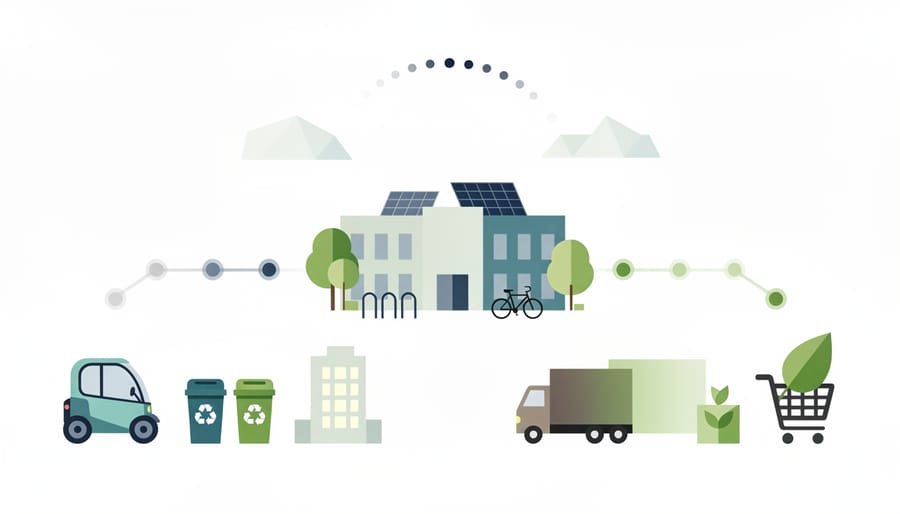
Managing Scope 3 emissions starts with identifying where the biggest impacts hide in your value chain. Most organizations find that 3-5 categories account for 80% of their Scope 3 footprint. Focus there first rather than spreading resources thin across all fifteen categories.
Begin by collecting baseline data through supplier engagement surveys, spend analysis, and activity tracking. You don’t need perfect accuracy initially. Industry-average emissions factors let you estimate impacts from procurement spending, business travel miles, and waste volumes. Refine the data over time as you build supplier relationships and reporting systems.
Set category-specific reduction targets that align with your overall climate goals. A hospital might target a 20% reduction in supply chain emissions through vendor selection, while a university focuses on cutting business travel by promoting virtual conferences and regional partnerships.
Integrate Scope 3 criteria into procurement decisions from the start. Require suppliers to disclose their carbon footprints, prioritize vendors with science-based reduction targets, and factor emissions into total cost of ownership calculations. When evaluating facilities or equipment purchases, consider operational efficiency impacts that cut energy bills and downstream emissions simultaneously.
For employee-related categories, implement practical efficiency strategies. Shift to hybrid work models where feasible to reduce commuting emissions. When business travel is necessary, choose direct flights and ground transportation over connecting routes. Encourage carpooling programs and subsidize transit passes.
Address waste by conducting audits that identify diversion opportunities. Partner with haulers who provide detailed recycling and composting data. Many organizations discover that switching to reusable food service items or reducing packaging in procurement cuts both waste emissions and costs.
Energy efficiency improvements in facilities you own reduce Scope 2 emissions directly, but they also model best practices for tenants and inspire similar actions throughout your value chain. Organizations investing in green energy plans and monitoring solar battery performance often share lessons learned with suppliers and partners, multiplying the impact.
Track progress quarterly and report transparently on both successes and challenges. Engage suppliers annually with updated expectations and recognition programs for top performers. This collaborative approach builds momentum and demonstrates that Scope 3 management delivers measurable results while strengthening business relationships.
Real Results: Scope 3 Reduction in Action
A mid-sized hospital network in the Pacific Northwest tackled its largest Scope 3 emissions source, purchased goods and services, by redesigning its medical supply procurement process. Medical supplies accounted for roughly 55% of the organization’s total carbon footprint, yet most suppliers couldn’t provide emissions data when the initiative launched in early 2024.
Rather than waiting for perfect information, the sustainability team started with a pilot program focused on three high-volume product categories: surgical kits, patient care supplies, and lab consumables. They worked with two preferred suppliers willing to share product-level carbon data and gave procurement preference to lower-carbon alternatives when clinical quality remained equivalent.
Within 18 months, the network reduced emissions from these categories by 23%. Key strategies included consolidating shipments to reduce transportation emissions, switching to reusable surgical instruments where clinically appropriate, and replacing single-use plastic items with lower-impact alternatives. The team also discovered that engaging clinical staff early, explaining why certain product changes mattered and addressing their concerns directly, proved essential to adoption.
The broader lesson: you don’t need complete value chain visibility to start. Focus on your highest-impact categories, partner with willing suppliers, and build momentum through quick wins. This hospital network has since expanded the program to eight additional product categories and influenced industry peers to adopt similar approaches.
Common Questions About Scope 3 Emissions
What’s the difference between Scope 2 and Scope 3 emissions?
Scope 2 covers indirect emissions from purchased electricity, steam, heating, and cooling that your organization consumes directly. Scope 3 includes all other indirect emissions in your value chain, from suppliers, business travel, employee commuting, waste disposal, and how customers use your products, essentially everything you influence but don’t directly control.
Do small organizations really need to track Scope 3 emissions?
Even small organizations benefit from understanding their Scope 3 footprint, especially as stakeholders, investors, and regulatory frameworks increasingly expect climate transparency. Start with the categories that matter most to your operations, often business travel, purchased goods, and employee commuting, rather than attempting to measure all 15 categories at once.
How accurate does Scope 3 data need to be initially?
Perfect accuracy isn’t the starting point. Begin with reasonable estimates using industry averages and supplier data where available, then improve data quality over time through better measurement systems and supplier engagement. What matters most is establishing a baseline and showing year-over-year improvement.
What if suppliers won’t share their emissions data?
This is one of the most common roadblocks. When direct supplier data isn’t available, use spend-based calculations, industry average emission factors, or work with suppliers to develop customization approaches that match their reporting capabilities. Many suppliers are developing their own carbon accounting and will share data as these practices mature.
Can Scope 3 reductions actually make a meaningful difference?
Absolutely, since Scope 3 typically represents 70-90% of an organization’s total carbon footprint, even modest reductions in high-impact categories deliver substantial results. Organizations that engage suppliers, shift to lower-carbon alternatives, and redesign processes around efficiency often see the greatest overall climate impact from their Scope 3 initiatives.
The challenges around Scope 3 measurement and reporting shouldn’t prevent organizations from starting. Many sustainability leaders focus initially on two or three high-impact categories where they have reasonable data access and direct influence, then expand their tracking and reduction efforts as internal processes and supplier relationships mature. This phased approach builds momentum and demonstrates tangible progress without overwhelming limited resources.
Managing Scope 3 emissions is no longer optional for organizations serious about climate impact. With these emissions accounting for the majority of most organizations’ carbon footprints, they represent both your greatest climate challenge and your biggest opportunity for meaningful reduction.
The organizations leading in Scope 3 management aren’t just meeting compliance requirements. They’re gaining competitive advantages through stronger supplier relationships, enhanced brand reputation, and deeper stakeholder trust. Investors, customers, and employees increasingly expect this level of commitment.
You don’t need to tackle all 15 categories at once. Start by identifying your highest-impact sources, typically purchased goods, business travel, or employee commuting, and build from there. Even modest initial efforts create momentum and demonstrate leadership.
The path forward begins with understanding your baseline, engaging your value chain partners, and setting realistic reduction targets. These steps position your organization as a climate leader while building the foundation for long-term sustainability success.
Ready to develop a Scope 3 strategy tailored to your organization’s unique footprint and goals? Our team helps universities, hospitals, government agencies, and businesses translate Scope 3 complexity into actionable reduction plans. Contact us to start your journey toward comprehensive carbon management.