Business sustainability is the practice of operating a company in ways that meet current financial goals while protecting environmental resources, supporting social equity, and ensuring the organization’s long-term viability. It goes beyond compliance or public relations to embed environmental and social considerations into core strategy, operations, and decision-making.
For energy-intensive organizations like hospitals, universities, manufacturing facilities, and municipal buildings, sustainability has become a strategic imperative. Rising energy costs, regulatory pressure, stakeholder expectations, and climate risk all push decision-makers to rethink how their facilities consume resources. A sustainable business model doesn’t sacrifice profitability for environmental performance. It aligns the two, treating energy efficiency, renewable procurement, and resource management as competitive advantages that reduce operating costs and strengthen resilience.
This article provides the conceptual framework you need to understand business sustainability and shows how it translates into energy strategy. You’ll find a clear breakdown of the three pillars that define sustainable operations, an explanation of how sustainability creates value across your organization, and the specific energy practices that turn theory into measurable results. We’ll also walk through real examples of organizations that have reduced energy consumption, cut costs, and met ambitious climate commitments without disrupting core operations.
Whether you’re building your first sustainability program or refining an existing one, the strategies and case studies ahead offer a practical roadmap for integrating energy goals into a broader sustainability vision that delivers financial and environmental returns.
What Business Sustainability Means in Practice
Business sustainability rests on a three-part sustainability measure known as the triple bottom line: environmental stewardship, economic viability, and social responsibility. These pillars don’t function in isolation. When a hospital reduces energy consumption through upgraded HVAC systems, it simultaneously cuts greenhouse gas emissions (environmental), lowers operating costs (economic), and improves indoor air quality for patients and staff (social). That overlap is where sustainability delivers its greatest value.
The environmental pillar addresses how an organization impacts natural systems. This includes reducing carbon emissions, conserving water, minimizing waste, and protecting ecosystems. Energy sustainability typically forms the foundation here because energy use drives the majority of a company’s carbon footprint.
Economic sustainability means maintaining profitability while reducing resource consumption. Efficiency improvements that cut utility bills, renewable energy contracts that lock in predictable costs, and waste reduction programs that lower disposal fees all strengthen the bottom line. This isn’t about choosing between profit and the planet; it’s about recognizing that resource efficiency creates competitive advantage.
Social sustainability focuses on people: fair labor practices, employee health and safety, community engagement, and equitable access to resources. A university that invests in energy-efficient campus housing simultaneously reduces operational costs and improves student living conditions.
- Triple Bottom Line
- A framework measuring organizational success through environmental, economic, and social performance rather than financial profit alone.
- ESG
- Environmental, Social, and Governance criteria used by investors and stakeholders to evaluate a company’s sustainability practices and ethical impact.
- Carbon Neutrality
- Achieving net-zero carbon emissions by balancing emissions produced with an equivalent amount removed or offset.
- Renewable Energy Procurement
- The process of purchasing electricity from wind, solar, or other renewable sources, either through direct generation, power purchase agreements, or renewable energy credits.
- Energy Resiliency
- The capacity to maintain reliable energy supply during disruptions through backup systems, distributed generation, and smart grid technology.
Smart sustainability strategy leverages these interconnections. When the three pillars align, organizations reduce risk, attract investment, retain talent, and build resilience against future regulatory and market shifts.
How Business Sustainability Works
Business sustainability operates as a structured cycle that organizations repeat and refine over time. The process begins with assessment: measuring current environmental impact, resource consumption, and waste generation to establish a baseline. Companies examine energy use, water consumption, carbon emissions, and supply chain effects. This diagnostic phase reveals where the organization stands today and which areas present the greatest opportunities for improvement.
From that baseline, businesses set measurable goals tied to specific timelines. A manufacturing facility might target a 25% reduction in energy consumption by 2028, while a hospital system commits to sourcing 50% renewable electricity within three years. Effective goals follow the SMART framework, specific, measurable, achievable, relevant, and time-bound, making progress trackable rather than aspirational. Many organizations track energy baselines and indicators as foundational metrics because energy represents both the largest carbon footprint and the most controllable variable.
Strategy development translates goals into action plans. This phase determines which initiatives to pursue first, how to allocate budgets, and who owns each objective. A university might prioritize LED retrofits and HVAC optimization before pursuing solar installations. The strategy should customize energy plans to the facility’s unique operational patterns rather than applying generic templates that ignore building-specific constraints.
Execution brings the strategy to life through concrete projects: installing efficient equipment, launching employee engagement campaigns, switching suppliers, or redesigning processes. Each initiative requires project management, stakeholder coordination, and budget oversight. A commercial building owner executes sustainability through submetering installations, occupancy sensor deployments, and renewable energy procurement contracts.
Progress tracking closes the loop. Organizations monitor performance against goals using dashboards, utility data analysis, and regular audits. This measurement phase identifies what’s working, what needs adjustment, and where new opportunities emerge. The cycle then restarts: reassess, set new goals, refine strategies, execute improvements, and track results. Sustainability succeeds when it becomes embedded in standard operations rather than treated as a standalone initiative.
Core Components of Business Sustainability
Energy Management and Efficiency
Energy use typically represents one of the largest controllable expenses for most organizations and the primary source of their carbon footprint. Managing this resource effectively creates immediate financial benefits while advancing environmental goals, a combination that makes energy the natural starting point for business sustainability initiatives.
Energy management begins with understanding current consumption patterns through audits and monitoring systems. This baseline reveals where energy is wasted and which upgrades deliver the greatest return. Organizations then implement efficiency measures: LED lighting retrofits, HVAC optimization, building envelope improvements, and equipment upgrades that reduce consumption without sacrificing performance.
Beyond efficiency, renewable energy procurement shifts remaining consumption to clean sources. This includes on-site solar installations, power purchase agreements, or renewable energy certificates, depending on facility constraints and financial considerations.
The financial case is straightforward: efficiency projects often pay for themselves within three to five years through reduced utility bills, while avoiding future energy cost volatility. The environmental impact is equally measurable, each kilowatt-hour eliminated or switched to renewables directly reduces greenhouse gas emissions, creating progress toward carbon reduction targets that stakeholders increasingly demand.
Resource Conservation and Waste Reduction
Beyond energy, effective sustainability programs tackle how organizations use water, materials, and physical resources. Water management starts with measuring current usage, identifying inefficiencies (like leaks or outdated fixtures), and implementing conservation technologies. Many facilities cut water consumption 20-40% through low-flow equipment and process optimization.
Waste reduction focuses on diversion: keeping materials out of landfills through recycling, composting, and reuse programs. The goal isn’t just volume reduction but material efficiency, using less to achieve the same output. Circular economy principles take this further by designing waste out of operations entirely, treating byproducts as inputs for other processes.
Material efficiency examines procurement choices: selecting durable goods, reducing packaging, and choosing recycled-content products. These practices lower disposal costs, decrease raw material expenses, and reduce the environmental footprint of supply chains. When integrated with energy management, resource conservation creates compounding sustainability gains across operations.
ESG Compliance and Reporting
ESG (Environmental, Social, and Governance) compliance transforms sustainability from abstract commitment into verifiable performance. Measuring metrics like carbon footprint, Scope 3 emissions diversity ratios, and board composition gives stakeholders concrete evidence of progress. Public reporting through frameworks like GRI, SASB, or CDP standardizes disclosure, making companies comparable and accountable. This transparency builds investor confidence, satisfies regulatory requirements, and demonstrates governance integrity. Organizations that track and disclose ESG data can identify improvement opportunities earlier, respond to stakeholder expectations proactively, and differentiate themselves in markets where sustainability credentials influence purchasing and investment decisions. Robust ESG reporting isn’t bureaucratic overhead, it’s the measurement system that makes business sustainability credible and actionable.
Stakeholder Engagement
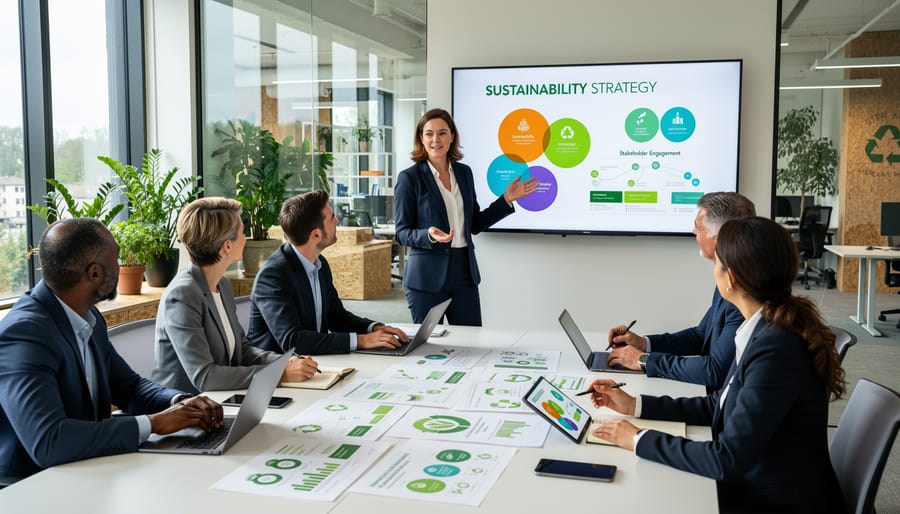
Sustainability programs succeed or fail based on the people behind them. A company can install solar panels and set ambitious carbon targets, but without employee buy-in, investor support, and community trust, those initiatives rarely deliver their full potential.
Employees drive daily operational decisions that affect energy use, waste generation, and resource efficiency. When staff understand why sustainability matters and how their actions contribute, they become active participants rather than passive observers. Simple steps like turning off equipment, reporting energy waste, or suggesting efficiency improvements compound into significant impact.
Customers increasingly reward businesses that demonstrate genuine environmental commitment. Transparent communication about sustainability efforts, specific actions taken, measurable results achieved, builds credibility and loyalty. Vague claims without data erode trust.
Investors now view sustainability performance as a risk indicator. Companies that engage shareholders through detailed ESG reporting, clear energy reduction targets, and progress updates attract capital more easily and often secure better financing terms. Community engagement matters equally: local stakeholders affected by business operations expect dialogue about environmental impact, job creation, and resource use. Partnerships with local organizations, participation in community sustainability initiatives, and responsiveness to concerns strengthen the social license to operate.
Where Business Sustainability Creates Impact

Business sustainability drives measurable change across every sector of the economy, though the specific focus areas and implementation strategies vary widely based on operational realities. A commercial office building’s sustainability program looks different from a hospital’s, yet both pursue the same fundamental objectives: lower environmental impact, reduced operating costs, and stronger stakeholder relationships.
The most effective sustainability initiatives emerge when organizations align environmental goals with their core operations rather than treating them as separate add-ons. In practice, this means:
- Commercial buildings and offices focus on HVAC optimization, lighting upgrades, and smart building systems to cut energy bills while improving tenant comfort
- Universities and educational institutions prioritize renewable energy procurement, campus-wide efficiency retrofits, and sustainability education integrated into curriculum
- Healthcare facilities balance critical 24/7 operations with energy-intensive equipment upgrades, medical waste reduction, and water conservation
- Government agencies demonstrate leadership through public building efficiency mandates, fleet electrification, and transparent sustainability reporting
- Manufacturing operations target process optimization, waste heat recovery, and circular material flows to reduce both emissions and production costs
- Hospitality businesses implement water-saving fixtures, renewable energy systems, and waste diversion programs that guests can see and appreciate
These sector differences matter because sustainability success depends on choosing initiatives that align with actual resource consumption patterns. A data center burns through electricity cooling servers around the clock, making energy efficiency its primary sustainability lever. A hospital generates significant medical waste and uses massive amounts of water for sterilization, requiring waste management and conservation protocols alongside energy measures.
The common thread across all sectors is that energy management consistently delivers the fastest payback and most significant carbon reduction. Whether you operate a school, factory, or office tower, your largest controllable operating expense is typically energy, and your biggest emissions source is usually electricity and heating fuel. This makes energy efficiency and renewable power the universal starting point for business sustainability, regardless of industry context. Organizations that begin with comprehensive energy assessments quickly identify the highest-impact opportunities specific to their operations, creating momentum for broader sustainability initiatives.
Business Sustainability and Energy Goals: The Critical Connection
Energy sits at the heart of most sustainability strategies because it drives the largest share of business carbon emissions and operating costs. For commercial buildings, hospitals, universities, and industrial facilities, energy consumption typically accounts for 60-80% of total greenhouse gas output. This concentration creates a powerful dynamic: improving energy performance delivers measurable sustainability progress faster than almost any other intervention.
The connection runs deeper than carbon accounting. Energy goals provide concrete, quantifiable targets that translate abstract sustainability commitments into operational reality. When a university pledges carbon neutrality by 2040, that ambition becomes actionable through specific energy benchmarks: reduce electricity use per square foot by 25%, transition to 100% renewable power, upgrade HVAC systems to cut natural gas consumption by 40%. These targets can be tracked monthly, validated with utility data, and directly linked to both environmental impact and cost savings.
Setting effective energy sustainability goals requires three strategic decisions. First, establish a baseline by conducting a comprehensive energy audit that reveals current consumption patterns, identifies waste, and benchmarks performance against similar facilities. Second, define specific targets using metrics that matter to your organization, whether absolute reductions (cut energy use by 500,000 kWh annually), intensity improvements (reduce energy per patient-day by 15%), or renewable adoption milestones (source 50% of electricity from solar by 2028). Third, create an implementation roadmap that sequences projects by ROI, prioritizing high-impact, quick-payback measures like LED retrofits and controls optimization before tackling longer-term investments such as geothermal systems or battery storage.
The financial case strengthens the environmental one. Energy efficiency projects frequently achieve payback periods of 2-5 years, meaning every dollar invested returns savings that can fund the next phase of sustainability work. A hospital that cuts energy costs by $200,000 annually through efficiency gains creates a self-funding mechanism for renewable energy procurement or deeper retrofits. This virtuous cycle, where energy goals generate both carbon reductions and capital for further improvements, explains why energy strategy serves as the foundation for credible, lasting business sustainability.
Real-World Success: Business Sustainability in Action
The University of California, Davis demonstrates how integrated energy management translates sustainability commitments into measurable outcomes. Facing aging infrastructure and rising energy costs across 5,300 acres, UC Davis launched a comprehensive sustainability initiative targeting carbon neutrality by 2025.
The university started with an energy audit identifying lighting retrofits, HVAC optimization, and renewable energy as priority areas. Instead of tackling everything simultaneously, they sequenced projects based on return on investment and carbon impact. First, they replaced 14,000 lighting fixtures with LED alternatives, reducing lighting energy use by 75 percent. Next, they implemented building automation systems that adjusted heating and cooling based on occupancy and weather forecasts.
The biggest challenge was funding. Rather than waiting for capital budgets, UC Davis structured projects through energy service contracts that paid for themselves through verified savings. This approach eliminated the upfront cost barrier that stalls many sustainability initiatives.
For renewable generation, the campus installed a 16-megawatt solar farm and a combined heat and power facility that converted biogas from campus dining and agricultural operations into electricity. These projects required navigating regulatory approvals and utility interconnection agreements, a process that took 18 months longer than anticipated.
By 2023, UC Davis had reduced campus greenhouse gas emissions by 42 percent compared to 2008 levels while expanding facilities by nearly 1 million square feet. Energy costs stabilized despite enrollment growth and inflation. The sustainability program also created student engagement opportunities through research partnerships and internships, demonstrating how energy initiatives support multiple institutional goals simultaneously.
The lesson: sustainability works when organizations start with assessments, sequence projects strategically, and structure financing creatively rather than waiting for perfect conditions.
Common Questions About Business Sustainability

Business leaders often have similar questions as they explore sustainability programs. Understanding these fundamentals helps organizations move from planning to action with confidence.
How is business sustainability different from corporate social responsibility?
Business sustainability integrates environmental, economic, and social considerations into core operations and strategy, while corporate social responsibility typically focuses on philanthropic activities and community programs separate from business operations. Sustainability addresses how the business itself operates, whereas CSR often addresses how profits are used afterward.
What ROI can businesses expect from sustainability initiatives?
Energy efficiency upgrades typically deliver 15-30% cost savings within the first year, with payback periods ranging from two to five years depending on the project. Beyond direct savings, organizations see benefits in employee retention, brand reputation, regulatory compliance, and access to capital from ESG-focused investors.
How long does it take to see results from sustainability programs?
Energy management initiatives often produce measurable results within months, particularly lighting upgrades and HVAC optimization. Comprehensive sustainability transformation takes three to five years to fully implement, though specific projects deliver value incrementally throughout that timeline.
What are the most common barriers to implementation?
Organizations most frequently cite upfront capital costs, lack of internal expertise, competing priorities, and difficulty measuring impact as implementation challenges. Starting with no-cost or low-cost energy efficiency measures helps build momentum and demonstrate value before larger investments.
How do you measure sustainability progress?
Track energy consumption per square foot, carbon emissions in tons of CO2 equivalent, waste diversion rates, water usage, and percentage of renewable energy in your mix. Establish baseline measurements, set annual targets, and report progress quarterly to maintain accountability and identify improvement opportunities.
These questions reflect the practical concerns organizations face when beginning their sustainability journey. The answers reveal that success depends less on having all the answers upfront and more on starting with measurable projects that build expertise and stakeholder confidence over time. Energy initiatives provide the clearest path to early wins because the metrics are straightforward and the financial benefits are immediate.
Business sustainability has moved from corporate responsibility checkbox to competitive necessity. Organizations that treat it as optional risk falling behind on multiple fronts: rising energy costs, tightening regulations, investor expectations, and talent recruitment. The question is no longer whether to pursue sustainability, but how quickly you can make meaningful progress.
Energy sustainability goals offer the clearest path forward. They deliver measurable results faster than most sustainability initiatives, with direct impact on your bottom line. An energy assessment reveals exactly where you’re losing money to inefficiency, while upgrades to lighting, HVAC, and building controls typically pay for themselves within three to five years. You’re not choosing between profit and planet, you’re addressing both simultaneously.
Start with what you can control. Conduct a comprehensive energy audit to establish your baseline. Identify your highest-consumption areas and prioritize efficiency improvements there. Set specific, time-bound targets for reduction. These concrete steps build momentum and demonstrate commitment to stakeholders while generating cost savings that fund further sustainability efforts.
The organizations gaining ground in 2026 recognize that sustainability creates lasting competitive advantage: lower operating costs, stronger brand reputation, better employee retention, and privileged access to capital. Those who postpone action will find themselves explaining inaction to increasingly skeptical investors, customers, and communities. The most practical choice you can make today is getting your energy house in order.