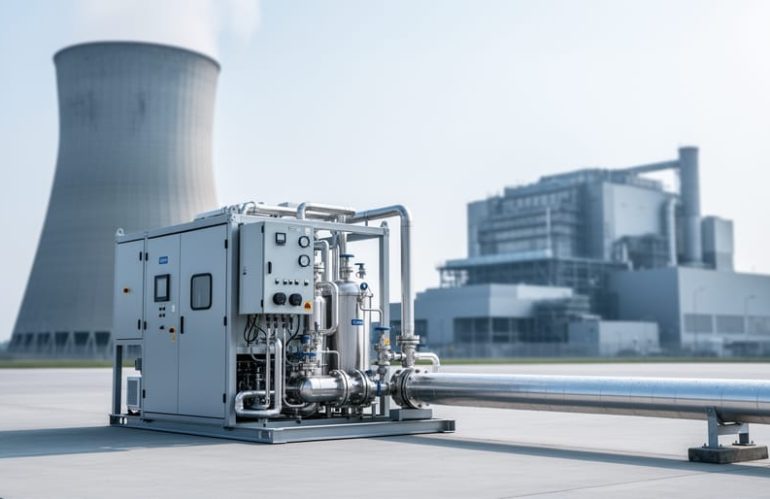
Nuclear hydrogen production uses the thermal energy or electricity from nuclear reactors to split water into hydrogen and oxygen, creating a carbon-free fuel source without burning fossil fuels. Unlike conventional hydrogen production methods that generate significant CO₂ emissions, nuclear-powered processes tap into a reliable, high-energy source that can operate continuously regardless of weather conditions or time of day.
For sustainability officers and facility managers evaluating clean energy pathways in 2026, nuclear hydrogen represents a practical solution to two pressing challenges: decarbonizing industrial processes that can’t easily electrify and creating energy storage options for grid stabilization. The technology matters because hydrogen demand is projected to grow substantially across sectors like steel manufacturing, ammonia production, and heavy transport, yet roughly 95% of current hydrogen still comes from natural gas reforming.
This article explains the core technical approaches to nuclear hydrogen production, from high-temperature steam electrolysis to thermochemical water splitting, and clarifies which reactor designs work best for each method. You’ll learn how these systems compare in efficiency and capital requirements, see real-world examples of operational facilities, and understand where nuclear hydrogen fits alongside renewable options in your organization’s decarbonization strategy. Whether you’re managing a hospital campus exploring backup power alternatives or overseeing a university district energy system, the framework here will help you assess if nuclear hydrogen aligns with your timeline, budget, and sustainability commitments.
What Nuclear-Powered Hydrogen Production Means
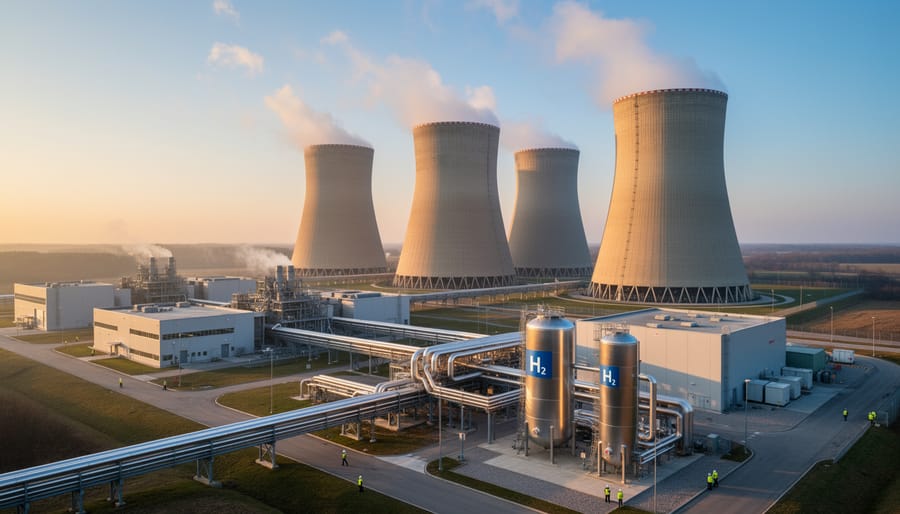
Nuclear-powered hydrogen production combines two mature technologies, nuclear fission and hydrogen generation, to create clean fuel without burning fossil fuels. At its core, this approach uses the heat or electricity generated by a nuclear reactor to split water molecules (H₂O) into hydrogen (H₂) and oxygen (O₂). The hydrogen can then be stored, transported, and used as a zero-emission fuel for industry, transportation, or power generation.
The fundamental advantage lies in the carbon-free energy source. Traditional hydrogen production relies overwhelmingly on natural gas through a process called steam methane reforming, which releases significant carbon dioxide. Nuclear reactors, by contrast, produce no direct greenhouse gas emissions during operation. When you pair that characteristic with water-splitting technologies, you get hydrogen that carries no carbon footprint from production through use.
- Nuclear Electrolysis
- The process of using electricity generated by a nuclear reactor to power electrolyzers that split water into hydrogen and oxygen. This method leverages the reactor’s continuous, carbon-free power output.
- Thermochemical Cycles
- Chemical reactions that use high-temperature nuclear heat (above 700°C) to break water molecules apart without requiring electricity. These multi-step processes can achieve higher efficiencies than conventional electrolysis.
- Clean Hydrogen
- Hydrogen produced with minimal or zero greenhouse gas emissions throughout the production process. Nuclear-derived hydrogen qualifies as clean because the reactor generates no carbon dioxide during operation.
This technology matters now because many industrial processes require hydrogen as a chemical feedstock, not just as fuel. Steel mills, ammonia plants, and refineries currently source most of their hydrogen from fossil fuels. Nuclear hydrogen production offers a pathway to decarbonize these essential operations without redesigning the underlying industrial processes. The hydrogen itself remains chemically identical regardless of production method, which means facilities can substitute nuclear-derived hydrogen for gray hydrogen with minimal operational changes.
The concept isn’t theoretical. Several countries are operating demonstration projects that couple nuclear reactors with hydrogen production equipment, proving the technical viability at commercial scale.
How Nuclear Hydrogen Production Works
Electrolysis Using Nuclear Electricity
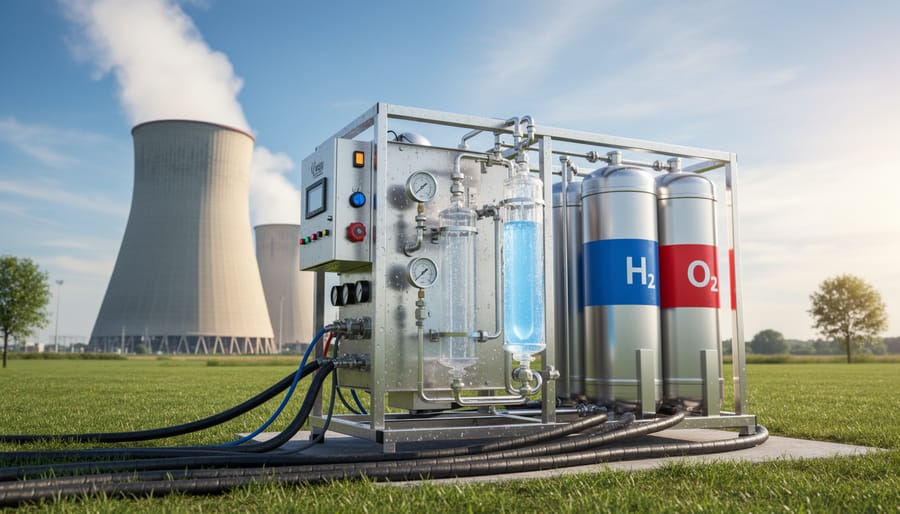
Nuclear reactors produce continuous, carbon-free electricity, often far more than the grid needs during off-peak hours. Instead of curtailing this excess generation, operators can route it to electrolyzers installed on-site or nearby. The electrolyzer applies an electric current to water, breaking the H₂O molecules into hydrogen gas at the cathode and oxygen at the anode. This process, known as nuclear-powered water electrolysis delivers hydrogen without combustion or fossil fuel inputs.
Most existing nuclear plants use proven alkaline or proton-exchange membrane (PEM) electrolyzers. Alkaline units are less expensive and durable for continuous operation, making them suitable for base-load nuclear facilities. PEM electrolyzers respond faster to variable power supply, which matters if the reactor also serves grid demand that fluctuates.
The efficiency of the entire chain, reactor thermal efficiency multiplied by electrolyzer efficiency, typically ranges from 25% to 35% for current light water reactors paired with standard electrolyzers. That means roughly three to four kilowatt-hours of nuclear heat are needed to produce one kilowatt-hour’s worth of hydrogen energy. While this sounds modest, the carbon intensity remains near zero because no fossil fuels are burned at any stage.
Nuclear plants already operate around the clock, so they can feed electrolyzers continuously rather than intermittently. This steady hydrogen output simplifies downstream logistics: storage tanks fill predictably, and industrial customers receive reliable supply without the variability that comes with wind or solar coupled to electrolysis. For organizations replacing gray hydrogen in refineries or chemical plants, this consistency reduces the need for oversized storage buffers and backup systems.
High-Temperature Steam Electrolysis
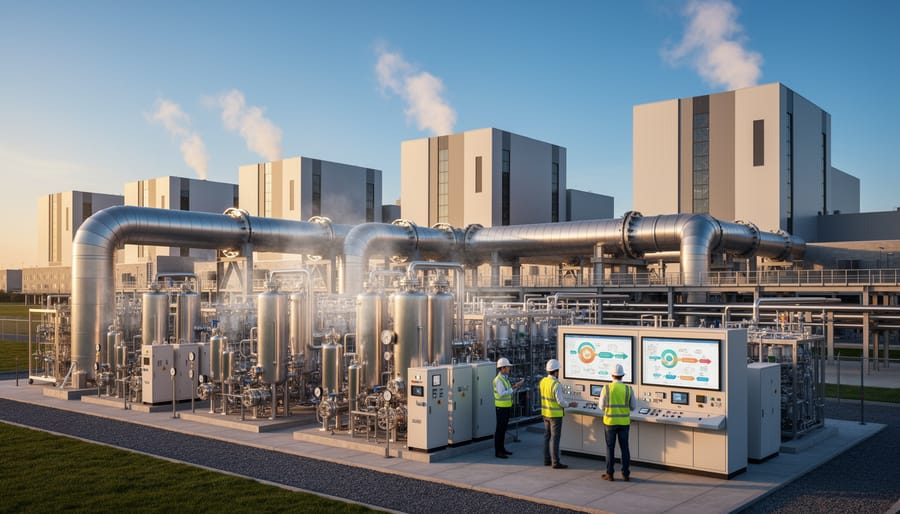
High-temperature steam electrolysis (HTSE) represents a significant efficiency leap over conventional water splitting because it takes advantage of the substantial heat output from advanced nuclear reactors. Instead of feeding room-temperature water into an electrolyzer, this method uses steam heated to 700-900°C, which dramatically reduces the electrical energy required to break the hydrogen-oxygen bonds.
The physics is straightforward: hotter molecules move faster and require less additional energy to overcome the activation barrier for splitting. In practical terms, HTSE can achieve 35-45% higher efficiency than cold electrolysis, meaning your facility produces more hydrogen per kilowatt-hour of nuclear energy consumed. This efficiency gain translates directly into lower operating costs and faster payback periods for capital investments in electrolysis equipment.
Advanced reactor designs, particularly high-temperature gas reactors and molten salt reactors, are ideally suited for HTSE because they routinely operate at temperatures well above what light water reactors can deliver. The reactor’s thermal output does double duty: generating electricity to power the electrolyzer and providing the high-grade heat that pre-energizes the water molecules.
Organizations evaluating nuclear hydrogen production should recognize that HTSE requires specialized solid oxide electrolyzers capable of handling extreme temperatures, which increases upfront equipment costs. However, the long-term efficiency advantages typically justify the investment when production scales exceed several tons of hydrogen daily. The technology is commercial, with operating installations in Japan and demonstration projects across Europe showing reliable performance over multi-year operational cycles.
Thermochemical Water Splitting
Thermochemical water splitting bypasses electricity generation entirely by using nuclear reactor heat in multi-step chemical reactions that break water into hydrogen and oxygen. Thermochemical water splitting cycles require temperatures above 800°C, making them suitable for high-temperature gas reactors or molten salt reactors rather than conventional light water designs.
The most studied approach is the sulfur-iodine cycle, which operates at roughly 900°C and converts water to hydrogen through three chemical steps involving iodine and sulfur dioxide. All reagents are recycled internally, so the only inputs are water and heat, and the only outputs are hydrogen and oxygen. This direct thermal route achieves higher overall efficiency than electrolysis, typically converting 45-50% of the nuclear heat into hydrogen’s chemical energy.
The trade-off is complexity. These cycles demand corrosion-resistant materials, precise temperature control across multiple reaction vessels, and advanced reactor designs that can reliably deliver the necessary heat. While several demonstration projects have validated the chemistry at laboratory scale, no commercial thermochemical plant operates today. Organizations evaluating this pathway should view it as a longer-term option dependent on next-generation reactor deployment rather than an immediate solution.
Types of Nuclear Reactors for Hydrogen Production
Light Water Reactors
Light water reactors represent the most readily available pathway for nuclear hydrogen production because they already form the backbone of commercial nuclear power worldwide. These reactors, which include pressurized water reactors (PWRs) and boiling water reactors (BWRs), generate electricity at temperatures between 280°C and 325°C, making them well-suited for conventional electrolysis but less optimal for high-temperature processes.
The primary advantage lies in immediate deployment. Existing light water reactors can dedicate a portion of their electrical output to on-site electrolyzers without requiring reactor modifications. A typical 1,000 MW plant could allocate 200-300 MW to hydrogen production during off-peak hours when electricity prices drop, effectively monetizing otherwise curtailed capacity.
However, efficiency remains a consideration. Standard alkaline or PEM electrolyzers paired with light water reactors achieve approximately 60-70% overall efficiency from nuclear heat to hydrogen energy. This compares unfavorably to advanced systems but offers the crucial benefit of leveraging proven, licensed technology that operators already understand and regulators have approved for decades of safe operation.
Several utilities now run pilot programs connecting electrolyzers to operating light water reactors, demonstrating the commercial readiness of this approach for organizations seeking near-term hydrogen solutions.
Advanced High-Temperature Reactors
Advanced High-Temperature Reactors represent a significant leap forward from conventional nuclear technology. These reactors operate at temperatures exceeding 700°C, making them far more efficient for hydrogen production than traditional designs. Generation IV reactors and small modular reactors (SMRs) in this category include high-temperature gas-cooled reactors (HTGRs), molten salt reactors, and sodium-cooled fast reactors.
The higher operating temperatures enable these reactors to drive thermochemical hydrogen production cycles directly, eliminating the efficiency losses inherent in converting heat to electricity first. For example, HTGRs can reach 950°C, hot enough to support sulfur-iodine thermochemical cycles that produce hydrogen at theoretical efficiencies above 50 percent.
Small modular reactors bring additional advantages. Their compact size allows deployment closer to industrial hydrogen users, reducing transportation costs and infrastructure requirements. Factory fabrication speeds construction and lowers capital costs compared to traditional large reactors. Several designs can operate in load-following mode, adjusting hydrogen production when electricity demand peaks and ramping up when grid demand drops.
Current advanced reactor projects specifically targeting hydrogen production include X-energy’s Xe-100 pebble-bed reactor and TerraPower’s Natrium design. These systems are engineered with hydrogen production as a primary mission rather than an add-on capability. Their passive safety features and walk-away safe designs address concerns that have historically slowed nuclear project approvals.
Hybrid Systems
Advanced reactors can operate in flexible modes that shift between electricity generation and hydrogen production depending on real-time grid conditions. When electricity demand peaks, the reactor directs its output to the grid. During off-peak hours or periods of excess renewable generation, the same reactor reroutes thermal energy to electrolyzers or high-temperature hydrogen production systems. This dual-mode capability improves the economics of nuclear plants by creating a revenue stream even when wholesale electricity prices are low. Organizations with variable energy needs, such as industrial sites that require both power and clean hydrogen feedstock, can reduce capital costs by deploying a single reactor instead of separate generation and hydrogen production facilities. Several projects in the United States and Canada are now testing hybrid nuclear hydrogen systems at demonstration scale.
Applications Across Sectors
Industrial Decarbonization
Heavy industries that currently rely on fossil fuel-derived hydrogen face mounting pressure to cut emissions. Steel mills, ammonia plants, and petroleum refineries together consume roughly 90 million tonnes of hydrogen annually, nearly all of it “gray hydrogen” produced from natural gas with significant CO₂ emissions. Nuclear-produced hydrogen offers a direct replacement pathway without changing industrial processes.
Steel manufacturers can substitute nuclear hydrogen in direct-reduced iron processes, eliminating scope 1 emissions from their primary production. The chemistry remains identical, hydrogen still reduces iron ore to metallic iron, but the carbon footprint drops dramatically. Early adopters report no need for equipment modifications beyond standard hydrogen purity requirements.
Ammonia production for fertilizers represents another major opportunity. The Haber-Bosch process requires pure hydrogen at scale, conditions that nuclear facilities can meet reliably. One advantage: nuclear plants provide the steady baseload supply that batch ammonia synthesis demands, unlike intermittent renewable sources that require costly buffering.
Refineries use hydrogen for hydrocracking and desulfurization. Switching to nuclear hydrogen cuts their largest single emission source while maintaining product specifications. The transition requires pipeline connections and storage expansion, not process redesign, making it feasible with existing capital infrastructure.
Heavy Transportation and Maritime Fuel
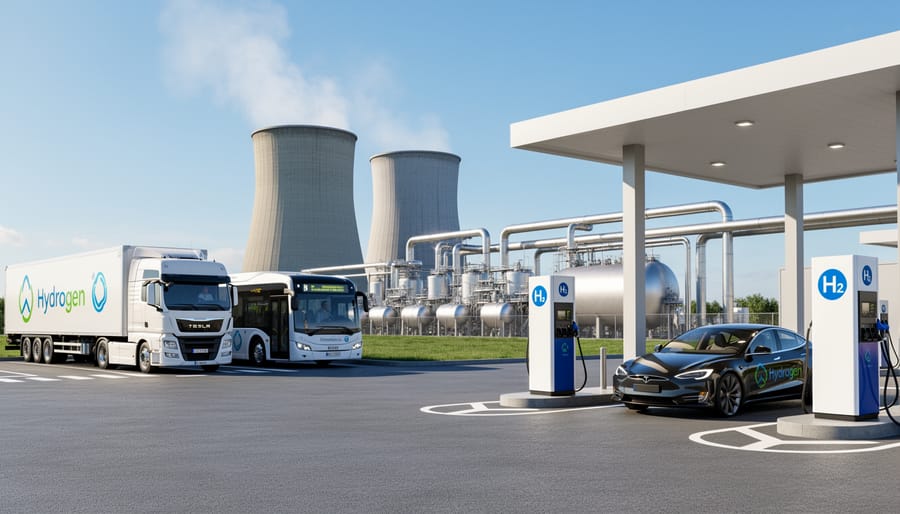
Long-haul transportation presents one of the most challenging decarbonization targets because batteries alone can’t meet the range, payload, and refueling speed requirements of heavy trucks, freight trains, and cargo ships. Nuclear-derived hydrogen offers a practical solution for these sectors.
Heavy-duty trucks operating hydrogen fuel cells can travel 500-700 miles on a single fill, matching diesel performance while eliminating tailpipe emissions. Rail operators are deploying hydrogen trains on non-electrified routes where installing overhead catenary systems would be cost-prohibitive. In maritime transport, where shipping accounts for nearly 3% of global carbon emissions, hydrogen fuel cells and hydrogen-derived ammonia are being tested as bunker fuel replacements for both container vessels and ferries operating coastal routes.
The advantage of nuclear hydrogen in these applications is consistent, large-scale production near ports and transportation hubs. A single nuclear facility can produce enough hydrogen to support regional trucking fleets or maritime refueling infrastructure without the land footprint required for equivalent renewable hydrogen production. Several port authorities are now evaluating co-location of small modular reactors with hydrogen refueling stations to serve both local shipping operations and freight corridors.
Grid-Scale Energy Storage
Nuclear-derived hydrogen offers a compelling solution for long-duration energy storage, the kind needed to bridge weeks or months when renewable generation falls short. Unlike batteries, which discharge over hours or days, hydrogen can store energy from spring through fall for winter heating demand, or bank summer solar surplus for cloudy stretches.
The process works in both directions. Nuclear plants produce hydrogen when electricity demand drops and wholesale prices sink, effectively converting excess baseload generation into storable chemical energy. When the grid needs power, fuel cells or gas turbines reconvert that hydrogen to electricity. This flexibility smooths the intermittency curve that plagues wind and solar portfolios.
Several utilities in the U.S. and Europe are piloting this approach. They inject hydrogen into existing natural gas pipelines at low percentages, typically 5-15%, to deliver stored energy without building new infrastructure. Others are constructing dedicated hydrogen storage in salt caverns, which can hold enough fuel to generate gigawatt-hours of electricity during multi-week demand peaks.
The economics improve where nuclear plants face curtailment or negative pricing during low-demand periods. Instead of throttling reactors, which is technically challenging and expensive, operators run at full capacity and convert surplus output to hydrogen. This maximizes asset utilization while creating a strategic reserve that stabilizes both the hydrogen market and the electric grid.
Economic and Environmental Benefits
Nuclear hydrogen production offers compelling economic advantages alongside substantial environmental benefits, making it an increasingly attractive option for organizations committed to decarbonization. The levelized cost of nuclear-derived hydrogen currently ranges from $2.50 to $4.50 per kilogram depending on reactor type and production method, positioning it competitively against gray hydrogen (which costs $1.50 to $2.50 per kilogram but carries significant carbon penalties) and approaching parity with green hydrogen from renewable electrolysis ($4.00 to $7.00 per kilogram). As carbon pricing mechanisms expand globally and more advanced reactor designs enter commercial operation, nuclear hydrogen costs are projected to decline 20-30% by 2030.
From an environmental perspective, nuclear hydrogen production delivers dramatic emissions reductions across the full lifecycle. Where conventional gray hydrogen from steam methane reforming generates 9-12 kilograms of CO2 per kilogram of hydrogen produced, nuclear pathways emit only 0.2-0.6 kilograms when accounting for reactor construction, fuel processing, and decommissioning. This represents a 95-98% reduction in carbon intensity, equivalent to or better than wind-powered electrolysis in most grid contexts.
The economic case strengthens further when considering operational stability. Nuclear plants provide baseload hydrogen production with capacity factors exceeding 90%, far surpassing renewable-powered electrolysis constrained by weather intermittency. This consistency translates to predictable supply contracts and lower storage requirements, reducing total system costs for industrial buyers who need reliable hydrogen streams. Organizations replacing fossil-based hydrogen in ammonia production, steelmaking, or refining can secure long-term price certainty while meeting increasingly stringent sustainability mandates and gaining regulatory advantages in jurisdictions implementing carbon border adjustments. The dual benefit of emissions elimination and cost predictability positions nuclear hydrogen as a strategic hedge against both climate policy risk and fossil fuel price volatility.
Real-World Implementation: Case Study
Japan’s Fukushima hydrogen demonstration facility offers a practical template for integrating nuclear power with hydrogen production at scale. Located near the Fukushima Daiichi site, this project uses a 10-megawatt alkaline electrolyzer powered by renewable sources and a nuclear-backed grid to produce approximately 900 tons of hydrogen annually. The facility began operations in 2020 with a clear mandate: prove that large-scale hydrogen production could support both industrial applications and regional energy resilience without relying on fossil fuels.
The project’s design addresses a common challenge in hydrogen economics, matching production capacity with demand fluctuations. By coupling electrolysis with nuclear baseload power and variable renewables, operators can ramp hydrogen output up or down based on grid conditions and storage needs. This flexibility matters because it demonstrates how nuclear hydrogen facilities can complement intermittent renewable sources rather than compete with them, a consideration that strengthens the business case for organizations evaluating comprehensive green energy plans across multiple technologies.
Measurable outcomes validate the technical and economic viability. The facility achieved a production efficiency of 4.3 to 4.8 kilowatt-hours per cubic meter of hydrogen, meeting commercial benchmarks for electrolytic systems. More importantly, it supplied fuel-cell buses and material-handling equipment across Fukushima Prefecture, logging over 50,000 operational kilometers with zero emissions. The hydrogen also fed into a 600-kilowatt fuel cell that returned power to the grid during peak demand periods, proving the reversibility concept that appeals to energy planners looking for storage solutions.
Cost data from the first three years shows production expenses declining as operational experience accumulated and electrolyzer runtime increased. Initial hydrogen cost approximately $6 per kilogram, with projections dropping toward $4 per kilogram as the facility scales and integrates more nuclear capacity. These figures position nuclear-derived hydrogen competitively against gray hydrogen in regions with carbon pricing or strict emissions mandates.
Common Questions About Nuclear Hydrogen Production
Is nuclear hydrogen production safe?
Nuclear hydrogen facilities operate under the same rigorous safety protocols as traditional nuclear power plants, with additional containment measures for hydrogen handling. Modern reactor designs incorporate passive safety systems that function without human intervention, and hydrogen production occurs in separate facilities connected to the reactor rather than within the reactor itself, reducing risk.
How does the cost compare to other hydrogen production methods?
Nuclear hydrogen production typically costs between $2 and $4 per kilogram when using high-temperature electrolysis or thermochemical cycles, making it competitive with green hydrogen from renewables and significantly cheaper than gray hydrogen once carbon pricing is factored in. The stable baseload nature of nuclear power eliminates the capacity factor challenges that affect solar and wind-based hydrogen production.
What timeline should we expect for deployment?
Organizations partnering with existing nuclear facilities can integrate electrolysis systems within 18 to 36 months. New dedicated nuclear hydrogen plants using advanced reactors require five to seven years from planning to operation, though this timeline decreases as standardized small modular reactor designs gain regulatory approval and manufacturing scales up.
What regulatory approvals are required?
Projects need nuclear facility operating licenses from national regulators, environmental permits for hydrogen production and storage, and compliance with industrial gas handling standards. In most jurisdictions, adding hydrogen production to an existing licensed nuclear site involves a modification approval rather than a full new licensing process, which accelerates timelines considerably.
Beyond these core questions, decision-makers often ask about infrastructure requirements and integration complexity. The good news is that nuclear hydrogen production pairs well with existing industrial infrastructure. If your facility already receives hydrogen via pipeline or truck, the delivery mechanisms remain the same, only the production source changes. For organizations without current hydrogen infrastructure, nuclear facilities can be sited near demand centers or connected to emerging hydrogen pipeline networks.
Water availability deserves attention in your planning. Nuclear hydrogen production requires substantial water input, though less per kilogram of hydrogen than cooling-intensive fossil fuel production methods. Coastal sites with seawater access or facilities near major waterways face fewer constraints than arid inland locations.
The skills gap represents another practical consideration. Operating nuclear hydrogen facilities requires personnel trained in both nuclear operations and hydrogen systems. Many organizations address this through partnerships with nuclear operators who handle the reactor side while industrial teams manage hydrogen purification, compression, and distribution. This division of responsibility lets you leverage nuclear expertise without building an entirely new capability in-house.
Nuclear hydrogen production represents a proven pathway for organizations committed to deep decarbonization without compromising operational reliability. The technology combines mature nuclear engineering with established hydrogen production methods, offering carbon-free fuel at scales that match industrial demand. Unlike intermittent renewable approaches, nuclear systems deliver consistent output year-round, making them particularly valuable for facilities with continuous hydrogen needs or regions where weather-dependent generation faces limitations.
For leadership teams evaluating this option, three practical steps can clarify its fit within your broader energy strategy. First, quantify your organization’s current and projected hydrogen consumption, production volume, purity requirements, and load patterns. Second, assess your site’s proximity to existing or planned nuclear facilities, as co-location dramatically improves economics. Third, engage with reactor developers and regional utilities to understand permitting timelines, available capacity, and partnership structures.
The convergence of advanced reactor deployment, corporate net-zero commitments, and policy support creates an actionable window for early adopters. Organizations that establish nuclear hydrogen supply chains now position themselves ahead of tightening emissions regulations while securing long-term fuel price stability.